Migration from SAP ECC to S/4HANA in 2026 is no longer purely a technological initiative; it has become a strategic decision with a direct impact on the operational stability and competitiveness of enterprises. The approaching end of support for ECC and the rising costs of maintaining legacy systems mean that organizations are no longer asking whether to migrate, but which path to choose. Market data clearly shows that nearly one third of companies have already completed the migration, while more than 40% plan to finalize it before 2027, placing 2026 at the center of ERP migration trends.
ECC deadline as a reference point, not the sole driver of decisions
SAP has officially announced that mainstream support for SAP ECC will end in 2027, which is a clear stimulus for migration and ERP transformation planning. However, the deadline itself does not fully explain the motivations behind enterprise decisions. Benchmark data shows that organizations are simultaneously making these decisions due to the need for better analytics, stronger system integration, and greater process automation.
According to the SAPinsider Migration Benchmark 2025, around 34% of organizations have already completed their migration to S/4HANA, and another 41% plan to complete it before ECC support ends (by 2027). This means that nearly three fifths of companies have already made a concrete commitment to operating in an S/4HANA environment before the deadline.
These figures confirm that migration is not merely a future plan—it is an ongoing process that is steadily gaining momentum. Meanwhile, some ECC users still have not made a decision or continue to postpone it, which increases the risk of executing projects under time pressure and with limited resource availability.
Preferred migration strategies: pragmatism first
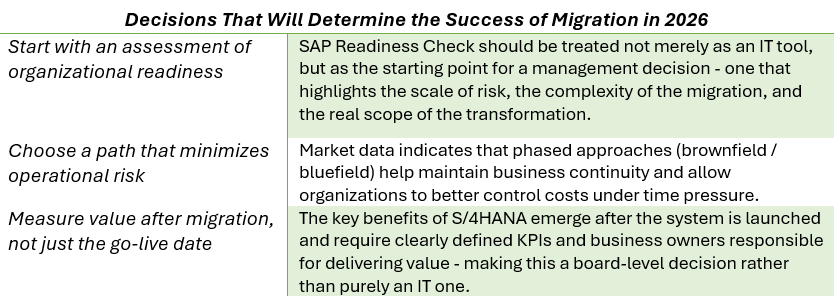
In practice, consultants and migration service providers observe that organizations increasingly choose strategies that maintain business continuity, such as brownfield or selective data transition (often referred to as bluefield) rather than a full and costly reimplementation (greenfield). This approach allows organizations to:
- preserve configurations and historical data
- reduce operational risk
- ensure a stable start in the new system
Such an evolutionary migration strategy is becoming the dominant implementation pattern in 2026
Cost and risk as key decision factors
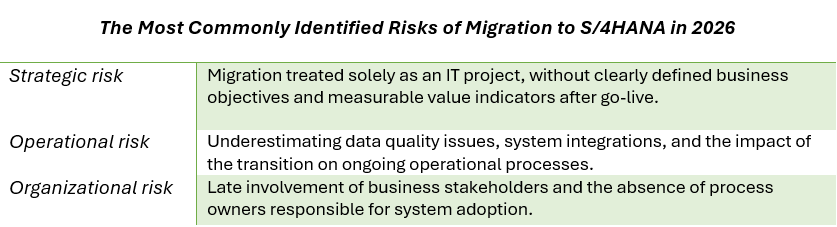
Industry reports indicate that cost and technological complexity remain the primary barriers to migration. In many organizations, delays in decision-making stem from concerns about:
- project and integration costs
- data quality
- the need for extensive testing before full deployment
These risks often lead decision-makers to adopt phased strategies that minimize operational disruption and enable more predictable implementation timelines.
Post-migration value: real benefits appear later
Experts emphasize that the greatest business benefits of S/4HANA—such as shorter process cycles and real-time analytics capabilities—usually emerge 6–24 months after go-live, provided that the migration is accompanied by a clear plan for realizing additional business value. This shifts the perspective from an “IT project” to a broader transformation program that extends well beyond the technological transition itself.
Key market differences
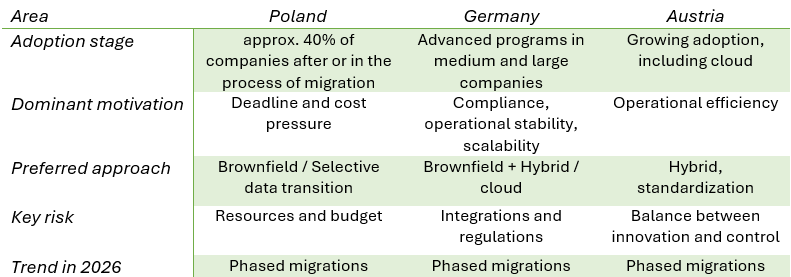
Although the ECC deadline is the same globally, local markets differ in their pace of adoption, preferred migration paths, and implementation barriers. The comparison of Poland, Germany, and Austria illustrates these differences.
Despite the shared migration driver, strategies vary depending on market specifics. In Poland, pragmatic decisions dominate, with a strong role played by implementation partners and phased approaches. Germany tends to invest in broader, well-planned transformations with a strong emphasis on governance and compliance. Austria combines operational efficiency needs with hybrid implementations, balancing stability with innovation.
Which path will dominate in 2026?
Market data clearly shows that there is no single universal migration path that will “win” in 2026. Instead, pragmatic strategies tailored to the realities of individual organizations will prevail. Brownfield approaches dominate in large organizations with significant legacy environments. Bluefield is growing the fastest as a compromise approach. Greenfield remains niche but important for cloud-first strategies.
Ultimately, the key success factor will not be the migration to S/4HANA itself, but the systematic measurement and realization of business benefits after the migration is completed.


